
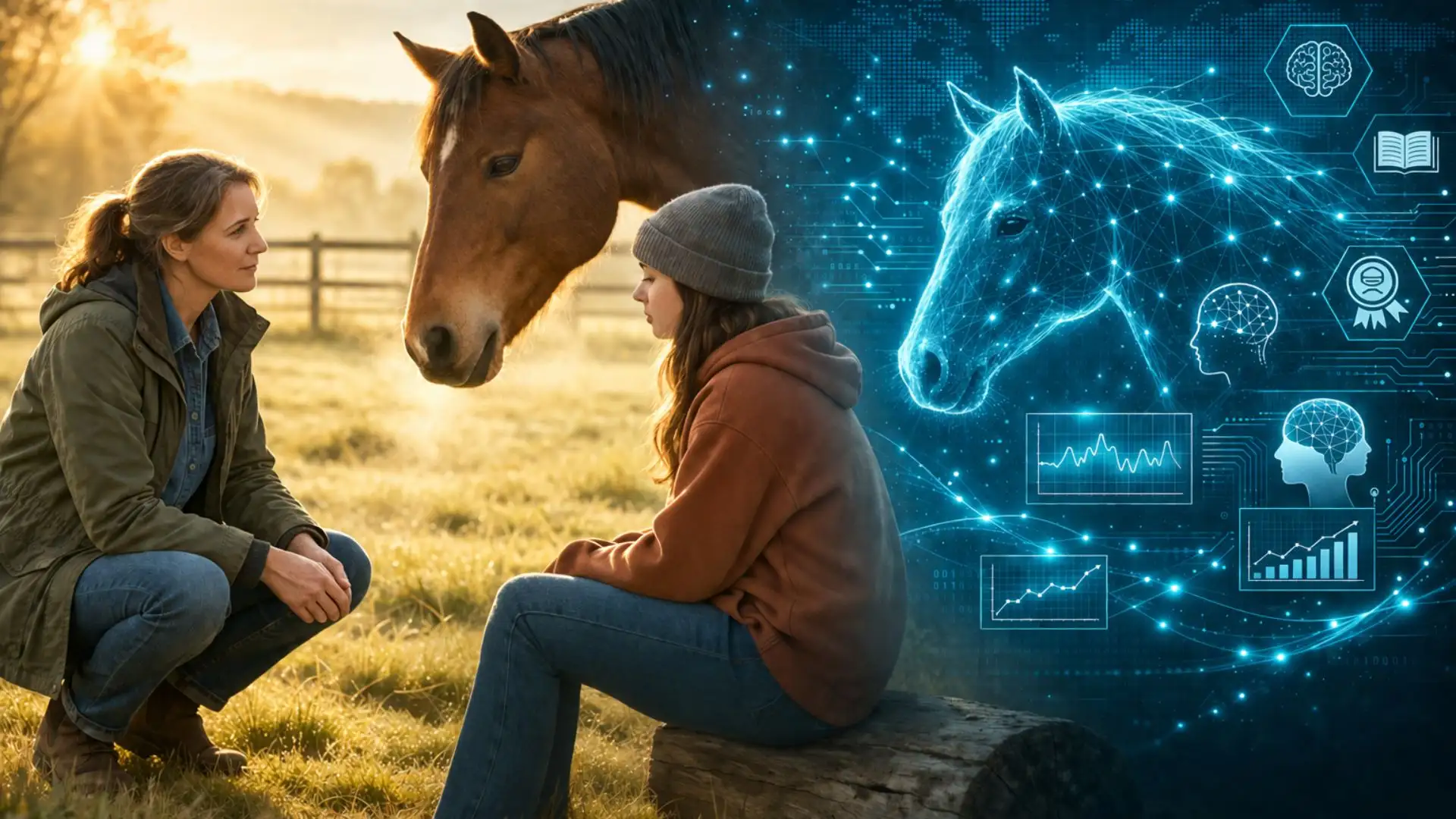
What AI Cannot Teach: The Value of Human Expertise and Horse Wisdom in
Equine Assisted Psychotherapy Training
Why Lived Experience Still Matters in Equine Assisted Psychotherapy Training
The rapid rise of artificial intelligence has changed the way training and courses is created and delivered across many industries. Equine Assisted Psychotherapy is no exception. There is now a growing volume of AI generated training entering the market, often promising low cost, high speed and convenience. While this may be appealing on the surface, it raises an important question for practitioners and students alike. What is lost when training is removed from psychotherapy skills, lived experience, horse-human connection, relational depth and the wisdom of the horse?
More Than Information: A Relational, Contextual Practice
At its core, Equine Assisted Psychotherapy is not simply knowledge to be learned. It is a relational practice that unfolds in real-time between human, horse (or horses), therapist and environment. It requires attunement, presence and the capacity to respond to subtle shifts in behaviour, emotion and nervous system states, in context, in relationship.
These are not skills that can be captured through knowledge, data sets or automated content generation. They are developed through experience, relationship, reflection and direct engagement with people and horses.
The Limits of AI Generated Training
AI generated training often relies on aggregated knowledge. It draws from existing material and presents it in a structured and accessible way. This can be useful for introductory knowledge and understanding.
However, it cannot include experiential and relational learning, it cannot hold the depth of insight that comes from years of clinical practice, nor does it carry the embodied knowing, values and ethics that are essential in this field.
The EAAPI Difference
The Equine and Animal Assisted Psychotherapy Institute, known as EAAPI, has built its training on a fundamentally human foundation that is informed by the wisdom of horses, the wisdom of nature. The EAAPI curriculum is an unique combination of intellectual property curated from an experiential integration of over 25 years of psychology, social work and psychotherapy graduate and postgraduate education,
qualification, lived experience, insight, awareness and relationship with horses.
Rather than relying on generic content, EAAPI programs are shaped by lived clinical experience, ongoing practice, radical and purposeful mission including human rights, justice and equity, alongside animal rights, justice and equity.
This means that our training is not just about what you know, what you do, but about who you are, what you believe, integrity, congruence and ‘inside-out learning’.
EAAPI training integrates counselling and psychotherapy theory and methodology, including somatic experiencing, parts work, polyvagal theory, cognitive-behavioural therapy and relational approaches alongside the horse as change agent, horse wisdom, program and session templates. These are not presented as isolated concepts but are woven into a cohesive methodology that is unique to us!
Developing Therapeutic Presence and Skill versus check-lists!
Students within EAAPI programs are guided to develop their own self-awareness, therapeutic presence and skilfulness, understand the language of the horse, work safely and ethically with complex client therapeutic needs and goals with horses who are actively consenting. The horse is an active participant in the therapeutic process, and are the sessions, if aligned with EAAPI model are mutually benefiting clients, horses and practitioners. This requires a level of awareness, skill, knowledge and responsibility that cannot be reduced to a checklist.
The Importance of Nuance
AI can summarise, categorise and replicate patterns, but it struggles with the grey areas that define therapeutic work.
How do you respond when a client becomes dysregulated with horses?
How do you include the horses’ shift in feelings or behaviour in session, in psychologically safe and effective ways for clients?
These moments require more than knowledge. They require attunement, judgement, sensitivity and the ability to remain present under pressure.
Choosing Depth Over Convenience
Choosing training in this field is not just about gaining information or convenience. It is about shaping the kind of practitioner you want to become. AI generated content may offer efficiency, but it cannot replace the depth of learning that comes from being guided by experienced practitioners who have walked the path themselves.
EAAPI invites students into a different kind of learning experience. One that honours the holistic intelligence of the human students, the horses, and the complexity of authentic relationship.
In a time where technology is rapidly advancing, there is real value in returning to what cannot be automated. Being human. Being Horse. Connecting. For Real.